
Reviewed · MEGALOCHORI & PYRGOS VILLAGE TOURS
Megalochori: Lost Atlantis 9D Experience Museum Entry Ticket
The most exciting part of this Megalochori visit is the 9D eruption experience, where shaking, wind, smoke, water sprays, bubbles, and simulated ash turn Santorini’s ancient disaster into a short theatrical ride. It is playful rather than scholarly, but it gives the Atlantis story a physical punch that a display case cannot.
I like the clear link between Plato’s myth and Santorini’s Minoan past, and I like the range of ways you learn: holograms, virtual windows, an animated Plato, a geological display, and the world’s largest Atlantis diorama. The main drawback is size. You can see the museum in roughly 45 minutes to an hour, so it works best as a focused stop rather than a half-day attraction.
In This Review
- Key points to know before you go
- Why Atlantis makes sense in Santorini
- Starting in Megalochori
- Plato, the ideal city, and the Atlantis theory
- The large Atlantis model and its virtual windows
- Santorini’s geological story in hologram form
- What happens during the 9D experience
- Dressing up as an Atlantis citizen
- How long the visit takes
- Is $16 a fair price?
- Who should make time for it?
- Booking and planning advice
- Should you book Lost Atlantis?
- FAQ
- Where is the Lost Atlantis Museum located?
- How long does the experience last?
- What is included in the ticket?
- Is the museum available in different languages?
- Is the museum wheelchair accessible?
- Is transportation from my accommodation included?
- Can I cancel my booking?
Key points to know before you go
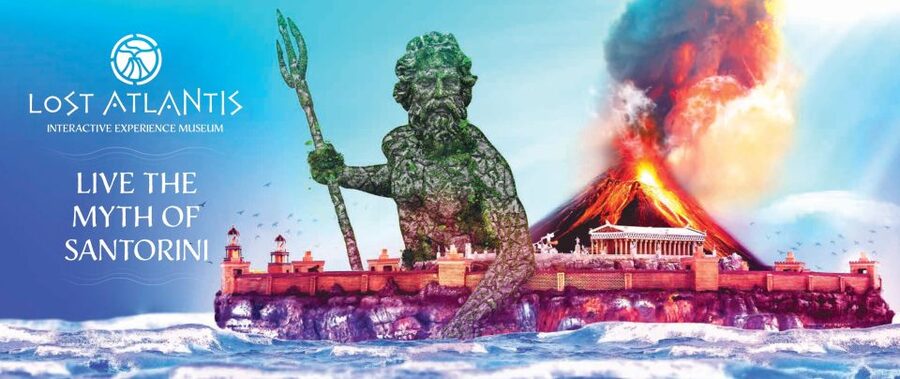
- The 9D show is the main event: Expect motion, wind, water, smoke, bubbles, and other effects as Atlantis meets its volcanic end.
- Plato becomes part of the exhibit: An animated hologram lets you ask about his philosophy and the idea that Santorini inspired Atlantis.
- The museum suits families: Interactive panels and virtual scenes make ancient history easier for children to follow.
- Pair it with Akrotiri: The museum offers a story-led introduction before you visit the real archaeological site.
- Allow 45 minutes to one hour: The compact visit fits neatly into a day around southern Santorini.
- The price is modest: At $16 per person, it offers a good indoor activity, especially when you want a break from sun, wind, or sightseeing.
Why Atlantis makes sense in Santorini
Plato’s Atlantis was an ideal island civilization destroyed by catastrophe. Santorini, with its enormous volcanic caldera and evidence of a Bronze Age eruption, has long invited comparisons.
The museum does not present the Atlantis theory as settled fact. Instead, it lays out the connection between Plato’s story, the Minoan world, and the eruption that reshaped Santorini. That distinction matters. You are getting a guided look at an intriguing theory, not proof that a lost city has been found.
I like this approach because it gives the famous myth a local setting. Santorini is often reduced to white buildings and sunset views. Here, you get a reminder that the island’s identity was shaped by fire, earthquakes, sea movement, and a civilization that existed long before the modern villages.
The experience is designed for a broad audience. You do not need a background in Greek archaeology, and children do not have to read long blocks of text to follow the main idea. Guides are present at the exhibits, and the material is available in Greek, English, French, German, Italian, Spanish, Turkish, and Chinese.
More Megalochori and Pyrgos village visits:
- Santorini: Mesa Gonia, Pyrgos and Oia Tour
★ 4.3 · 79 reviews - Megalochori: Horseback Riding Tour for Experienced Riders
★ 4.8 · 65 reviews - Santorini: Akrotiri Excavation, Megalochori, & Beaches Tour
★ 4.3 · 18 reviews
Starting in Megalochori
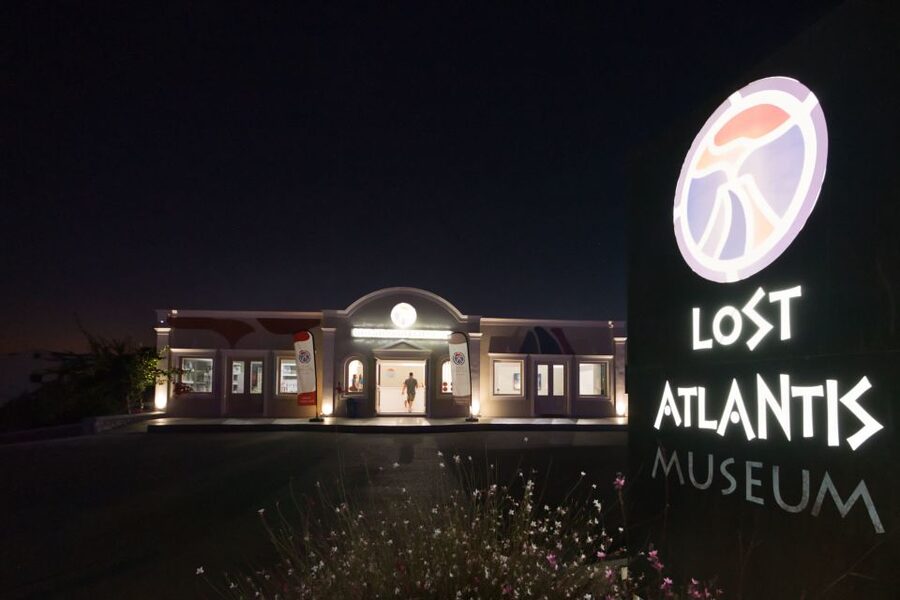
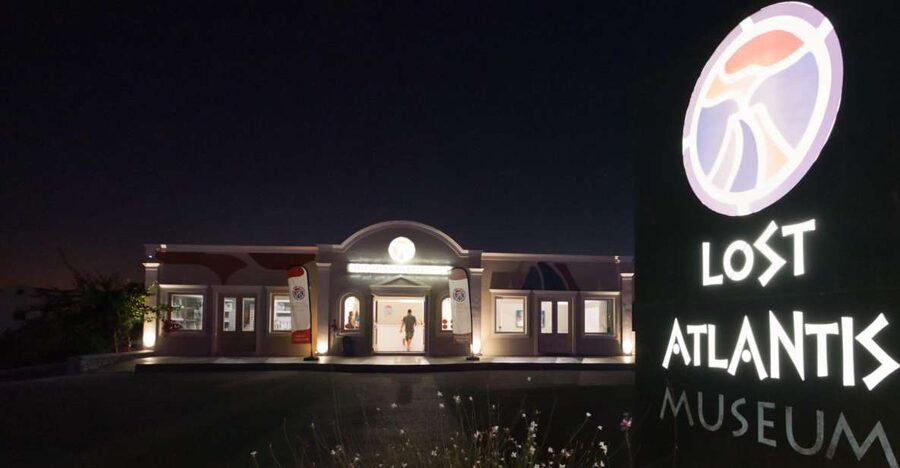
The museum is in Megalochori, at Lost Atlantis on the Epar.Od. Firon-Ormou Perissis road. The entrance is opposite the large Denaxas supermarket, a useful landmark when you are finding the site.
There is no hotel pickup or drop-off included, so you make your own way there. A local bus stop is about 100 yards away, and staff can offer advice about the next bus. That makes the museum easier to combine with other southern-island stops, though you should check your transport timing before setting out.
The location is particularly useful if you are already planning to visit Akrotiri. One visitor found it helpful to do the museum first, and I agree with that order. The museum gives you a simple story about the eruption and its possible connection to Atlantis. Akrotiri then gives you actual ancient remains to consider.
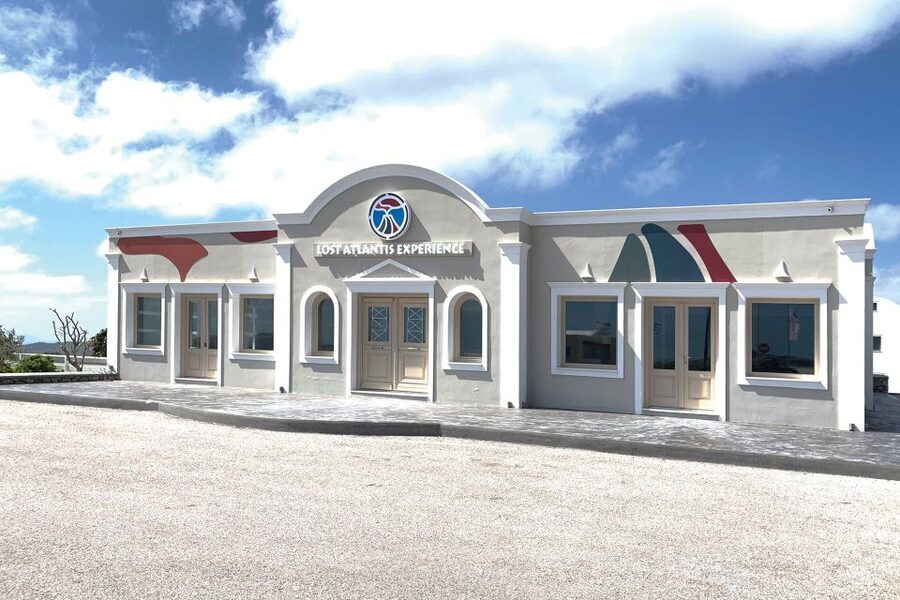
Do not expect a grand museum complex. The indoor space is compact, and one part of the visit may feel small if you prefer large galleries. That is also why the one-hour format works. You can fit it into a busy Santorini day without giving up half a day.
Plato, the ideal city, and the Atlantis theory
One of the more unusual exhibits brings Plato to life as an animated hologram. You can ask him about his philosophy and about the theory that Santorini may have inspired the Atlantis myth.
This is a clever way to handle a difficult subject. Instead of treating Plato as a name on a label, the museum makes him part of the conversation. The interaction is aimed at curiosity rather than serious philosophical debate, but it gives children and adults a reason to pause and think about how stories are built.
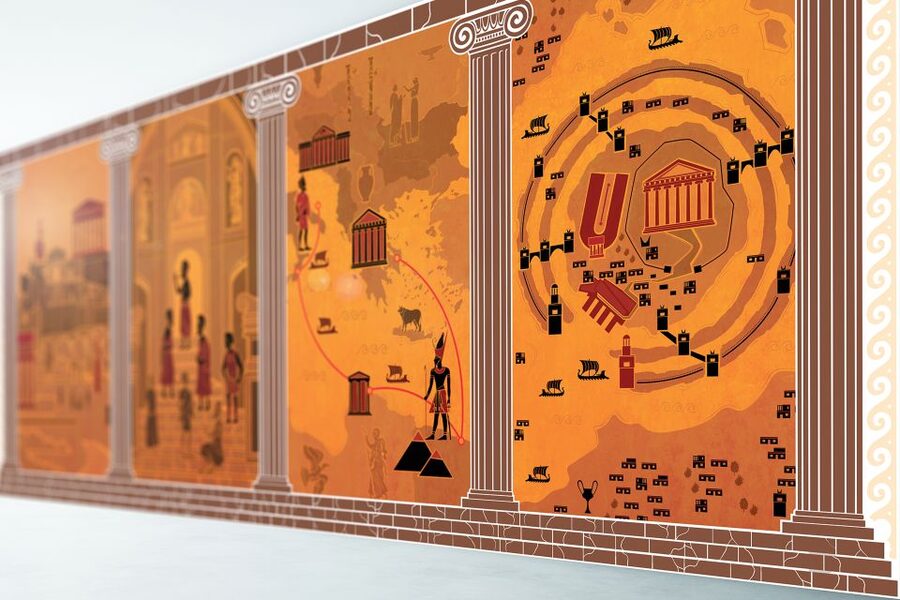
You also follow Plato’s journey through an interactive fresco. The display connects his ideas about an ideal city with the story of Atlantis. That helps you see the myth as more than a tale about a sunken place. Plato used Atlantis to explore society, power, virtue, and the dangers of corruption.
I would not come expecting a full lesson in classical philosophy. The visit is short, and the treatment is designed to be accessible. Still, the combination of Plato, Santorini, and the volcanic disaster gives the museum more substance than a simple special-effects attraction.
The large Atlantis model and its virtual windows
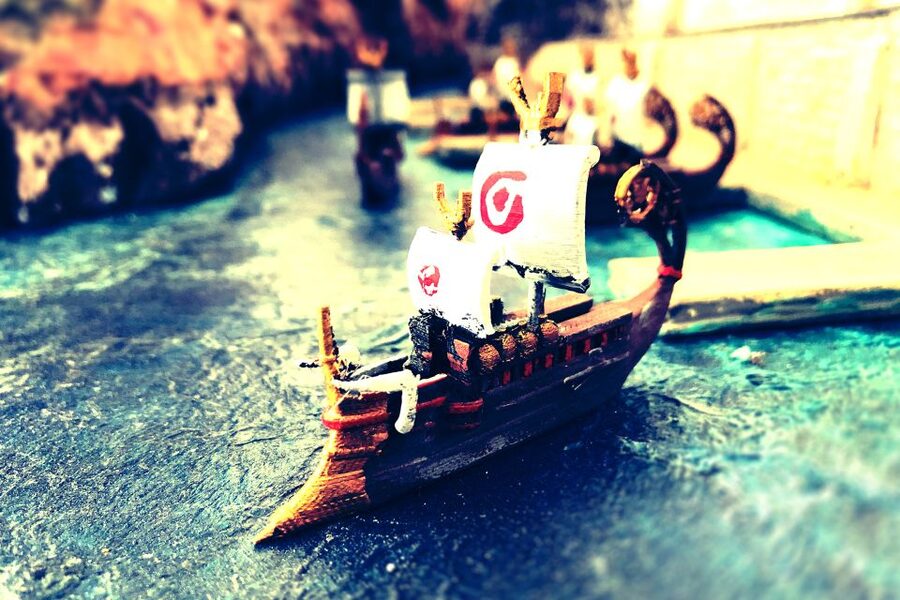
The largest Atlantis diorama in the world is one of the museum’s visual anchors. A model city lets you see Atlantis as a planned settlement rather than a vague underwater legend.
The size of the model matters because it gives the story physical shape. You can take in the streets, buildings, and layout at a glance. After hearing about destruction and disaster, it is useful to see what the city was supposed to be before everything went wrong.
The museum then uses augmented reality to show everyday life through virtual windows in time. These scenes are a good choice for families because they answer the simple questions children often ask: How did people live? What did the city look like? What happened before the eruption?
The technology is not there just for decoration. It translates an abstract ancient world into short visual moments. You may find the experience more like a themed historical attraction than a traditional museum, but that is precisely why it holds attention well during a brief visit.
There is a limit. A model and digital scenes cannot replace archaeological evidence. Treat them as a way to picture the theory, not as direct proof of Atlantis or a complete reconstruction of Minoan life.
More museums and galleries in Santorini:
- Santorini Small Group Guided E-bike Tour & Local Tomato Museum
★ 5.0 · 67 reviews - Wine Tour in Santorini with private guide, wine museum and tasting
★ 5.0 · 26 reviews - Santorini: Tomato Museum Admission Ticket with Audio Guide
★ 4.9 · 22 reviews - Visit to a Wine Museum and Wine Tasting in Santorini
★ 4.0 · 10 reviews
Santorini’s geological story in hologram form
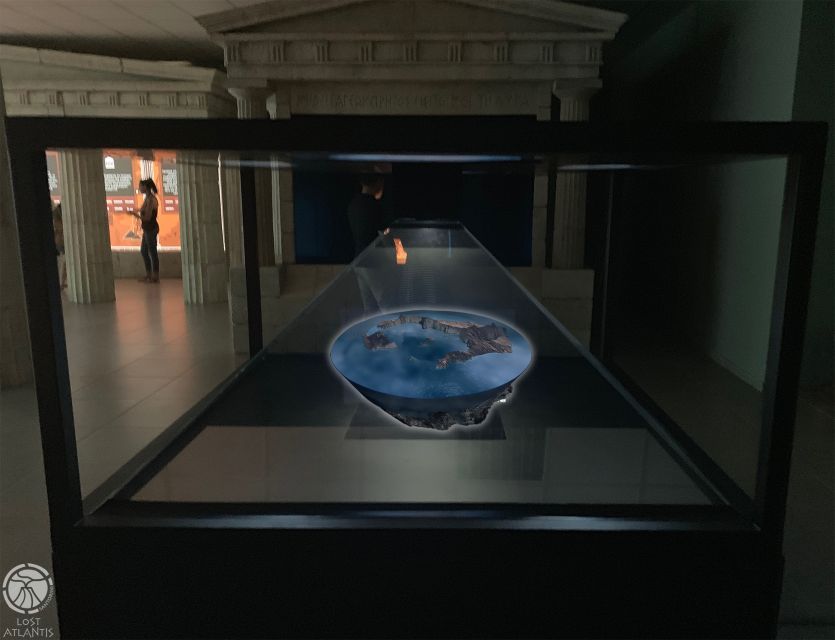
Another exhibit presents a holographic account of Santorini’s geological evolution, from prehistoric ages to the present.
This is valuable because the Atlantis idea makes more sense once you understand the island’s changing form. Santorini was not always the same collection of cliffs and caldera views you see today. Volcanic activity, eruptions, and geological change shaped the island over long periods.
The holographic format gives that process a visual sequence. Instead of trying to imagine ancient Santorini from a paragraph, you watch the island change through time. It is a concise introduction to the forces behind the famous caldera.
The display also helps separate two ideas that are easy to mix up: the geological story of Santorini and the literary story of Atlantis. The first is evidence-based earth science. The second is Plato’s account and the theory that the two may be connected. The museum places them beside each other so you can consider the link without having to accept it.
What happens during the 9D experience
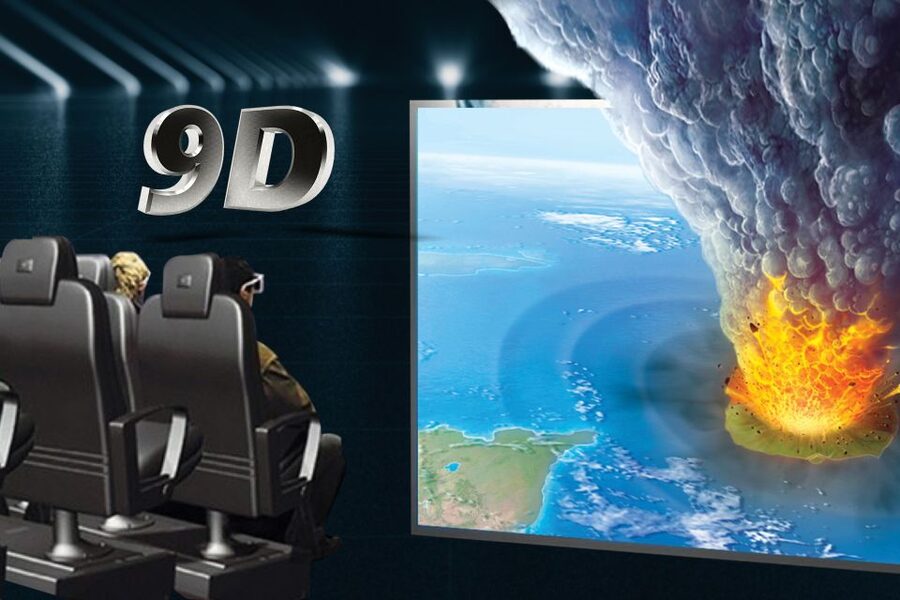
The final show recreates the destruction of Atlantis through a 9D presentation. The story includes an earthquake, tsunami, and volcanic eruption, and the effects are designed to involve more than your eyes and ears.
Expect movement, wind, water sprays, bubbles, smoke, simulated ash, and other physical effects. The aim is to make you feel the sequence of disaster rather than simply watch it on a screen. You may also walk on lava inside an active-volcano setting, adding another theatrical touch.
This is the part most likely to delight children and anyone who enjoys rides or cinema effects. Several people have singled out the film as the most memorable part, and it is easy to see why. The show turns a historical theory into a compact piece of entertainment.
It can also be a little much for anyone sensitive to motion or sudden effects. The supplied information does not give specific restrictions for the 9D show, so ask the staff if you have concerns before entering. The rest of the museum is calmer and can still be worthwhile if you choose not to take part in every effect.
Do not judge the show by the number in 9D. The label is a marketing term, not a scientific category. What matters is that the presentation adds physical effects to the story and gives the museum its strongest sense of occasion.
Dressing up as an Atlantis citizen
The museum also lets you dress up and take pictures as a citizen of Atlantis.
This is a small feature, but it adds a light, personal moment to a visit built around large ideas. Children can play along, and adults who enjoy a holiday photo get something more memorable than another picture of a museum sign.
It also shows the museum’s overall tone. This is not a silent archaeological collection where you move from object to object. It mixes education, theater, digital technology, and a little make-believe. If you want a strictly academic presentation, you may find it too playful. If you want history to feel approachable, the balance works well.
How long the visit takes
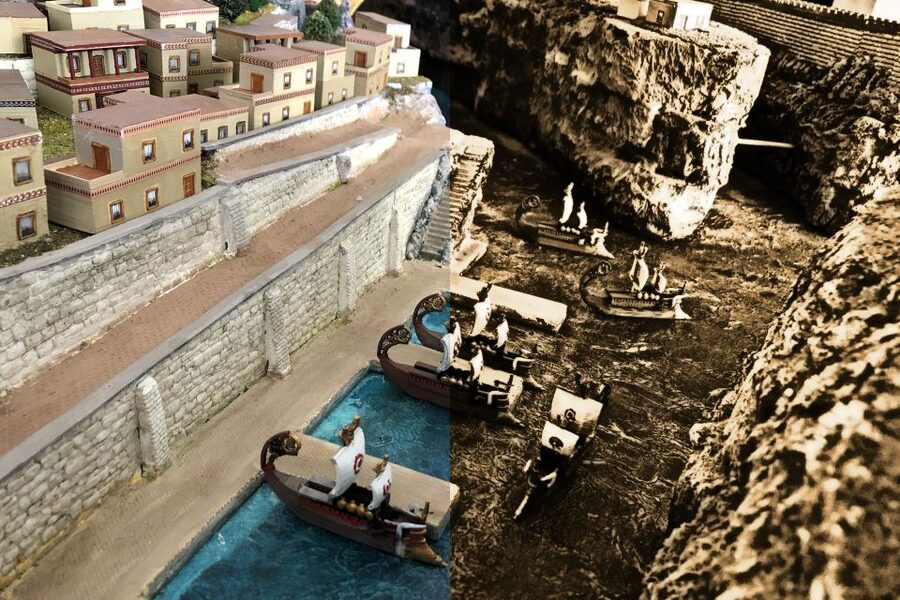
The stated duration is one hour, but you might finish in about 45 minutes if you move quickly. That is not a criticism. The compact timing is one of the attraction’s practical strengths.
You can visit before or after Akrotiri, use it as an indoor break, or fit it between other plans in southern Santorini. The museum is also useful on a day when heat, wind, or changing weather makes long outdoor sightseeing less appealing.
To get the best value, avoid treating the ticket as a quick photo stop. Give yourself time to read the explanations, try the interactive panels, speak with the guides, and watch the holographic displays. The visit is short enough that an unhurried pace is still easy.
The guides at the exhibits are part of the experience. They explain how the interactive panels work and help direct you through the correct order. That matters because the technology can otherwise feel like a collection of unrelated screens.
Is $16 a fair price?
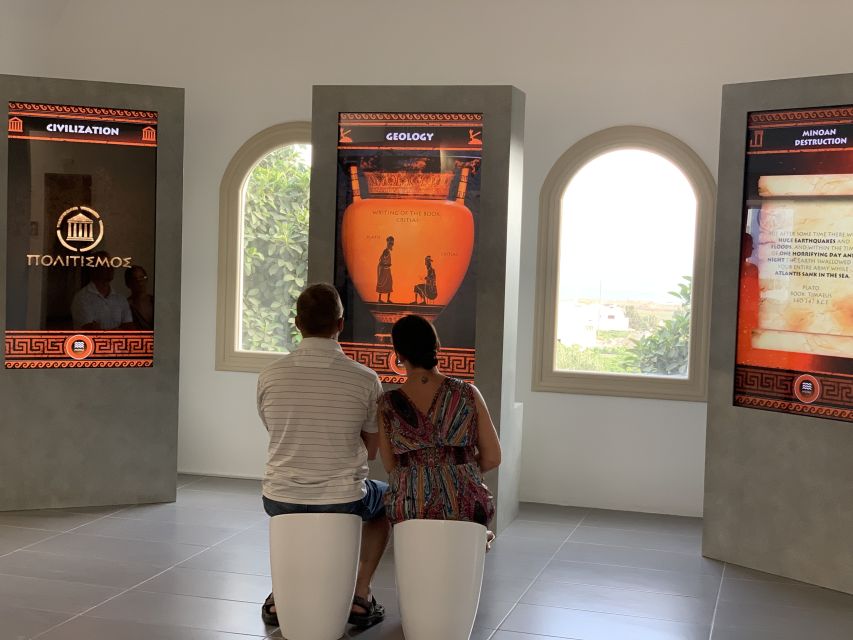
At $16 per person, the ticket is reasonably priced for an hour of guided, technology-based entertainment in Santorini. The value comes from the variety. You are not paying only for a film. The admission includes the 9D experience, the interactive displays, the Atlantis model, the virtual scenes, the holographic geology presentation, and staff guidance.
The price looks especially fair for families. A child who might lose interest at a conventional archaeological display has several things to do here. The story is simple enough to follow, and the effects give the visit a clear high point.
For a solo adult mainly interested in hard archaeological evidence, the value depends on your expectations. You are paying for interpretation and presentation, not a major collection of ancient objects. If you already plan to see Akrotiri, the museum works best as a lively introduction rather than a replacement.
There is also practical value in the one-hour length. Santorini activities can consume a whole morning once transport and waiting are added. This one gives you a defined, manageable stop for a moderate fee.
Who should make time for it?
I would recommend Lost Atlantis most strongly to families, first-time visitors who want context for Santorini’s volcano, and anyone planning to see Akrotiri. Children around primary-school age and older can follow the interactive material, and the 9D presentation gives them a reason to stay engaged.
It also suits solo visitors. The museum does not depend on having a large group, and the hologram, model, and interactive panels give you plenty to explore at your own pace.
History fans should come with a clear understanding of the format. You will learn about Minoan Santorini and the Atlantis theory, but this is not an excavation site or a specialist research center. For archaeological depth, pair it with Akrotiri rather than choosing one in place of the other.
The museum is wheelchair accessible, which makes it a practical indoor stop for more visitors. Pets and oversized luggage are not allowed, so plan accordingly.
Booking and planning advice
You can cancel up to 24 hours before the visit for a full refund, and the reserve-now, pay-later option keeps your plans flexible. Starting times vary, so check availability before booking.
The hosts speak English and Greek, while the exhibits offer eight languages: Greek, English, French, German, Italian, Spanish, Turkish, and Chinese. That makes the visit easier for international families and mixed-language groups.
Wear ordinary sightseeing clothes. You do not need special equipment, and food or drink is not included. Since the attraction is opposite Denaxas supermarket, that landmark should make the meeting point easier to recognize.
I would place the museum earlier in your Akrotiri day. You will have the Atlantis theory and the volcanic timeline in mind before seeing the ancient settlement. Afterward, you can decide how much of Plato’s story is supported by the real remains.
Should you book Lost Atlantis?
Book it if you want a short, entertaining way to understand why Santorini is linked with Atlantis. The strongest reasons are the excellent 9D disaster show, the friendly exhibit guides, and the mix of holograms, augmented reality, and physical models.
Skip it if you want a large collection of ancient artifacts or a long, quiet museum visit. The space is small, and the Atlantis connection remains a theory. At $16 for about an hour, though, it is a sensible addition to a southern Santorini itinerary, especially before Akrotiri and especially with children.
FAQ
Where is the Lost Atlantis Museum located?
It is in Megalochori, Santorini, at Lost Atlantis on Epar.Od. Firon-Ormou Perissis. The entrance is opposite the large Denaxas supermarket.
How long does the experience last?
The stated duration is one hour. You may see the museum in about 45 minutes if you move quickly.
What is included in the ticket?
The ticket includes the 9D experience and guides at the exhibits.
Is the museum available in different languages?
Yes. The exhibits are available in Greek, English, French, German, Italian, Spanish, Turkish, and Chinese. The hosts speak English and Greek.
Is the museum wheelchair accessible?
Yes, the activity is wheelchair accessible.
Is transportation from my accommodation included?
No. Hotel pickup and drop-off are not included. A local bus stop is about 100 yards away, and staff can provide advice about the next bus.
Can I cancel my booking?
Yes. You can cancel up to 24 hours in advance for a full refund. A reserve-now, pay-later option is also available.
Newest reviews from Santorini
- Santorini: Full-Day Small Group Tour★ 5.0 · 3 reviews
- Guided Tour: the Myth of Lost Atlantis★ 5.0 · 3 reviews
- Private Boat tour with snorkeling & Sea Caves★ 5.0 · 3 reviews
- Akrotiri: Singles’ Aromatherapy Massages★ 5.0 · 3 reviews
- Private Transfer from Santorini Airport to Santorini★ 5.0 · 3 reviews
- Santorini: Island Tour for Cruise Travelers★ 5.0 · 3 reviews
- Top Spots Bus Tour in Santorini with Transportation★ 3.5 · 3 reviews
- Half-Day Private Experience to Santorini Beach★ 5.0 · 3 reviews
Megalochori & Pyrgos Village Tours, compared.

Akrotiri Excavation, Megalochori, & Beaches Tour
Read our review →
Private Santorini 4-Hours Tour : Oia, Megalochori & wine tasting
Read our review →
2-hour Private Wooden E-Bike Tour in Emporio Castle, Santorini
Read our review →
Browse the lists this tour appears in