
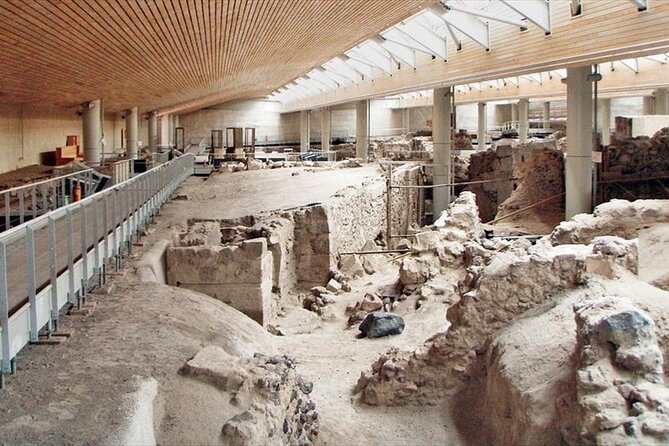
Reviewed · AKROTIRI EXCAVATIONS TOURS
Guided Tour to the Akrotiri Archaeological Site in Santorini
Akrotiri is the place to see Santorini before the white villages and cliffside hotels. This Bronze Age settlement was buried by the volcanic eruption dated here to 1612 BC, preserving cobbled lanes, tall buildings, work areas, and rooms that give you a sharper picture of ancient island life than a quick solo walk.
I like the licensed English-speaking guide, who can explain how the buildings worked rather than simply point at old walls. I also like the short format: about two and a half hours at most, with the rest of your day free. The main drawback is cost. At $181.10 per person, plus the separate €20 entrance fee, this is not a cheap way to visit an archaeological site, even though sharing the guide keeps the price below a private tour.
In This Review
- Key points to know before you book
- Why Akrotiri deserves a place on your Santorini schedule
- Starting in Fira and reaching the excavations
- Walking through the prehistoric streets
- The West House and the practical side of ancient life
- The Women’s House and its mural
- What the guide adds to a short visit
- Is $181.10 a good value?
- Timing, group size, and the rest of your day
- Who will enjoy this Akrotiri tour most?
- My verdict on booking
- FAQ
- How long does the Akrotiri tour last?
- Where does the tour start and end?
- Is the entrance fee included?
- What language is the tour offered in?
- How many people can join the group?
- Can I cancel for a refund?
Key points to know before you book
- Akrotiri preserves a real prehistoric town: Walk among streets, rooms, workshops, storage areas, and multi-story buildings rather than viewing a single monument.
- A guide adds useful context: The licensed English-speaking guide explains the settlement, its buildings, murals, and destruction in a way signs alone cannot.
- The group size is capped at 20: You get a shared tour rather than a private visit, but the limit should keep the group manageable.
- The €20 admission fee is extra: Children ages 0 to 18 enter free, while adults pay separately at the excavations.
- The tour begins and ends in Fira: Transfers are provided from the meeting point at KTEL Santorini, near the old hospital.
- You still have most of the day available: The main visit lasts about two hours, with the full experience listed at roughly two and a half hours.
Why Akrotiri deserves a place on your Santorini schedule
Santorini is usually presented through its caldera views, blue domes, and sunset crowds. Akrotiri gives you a different island. Here, you look beneath the modern postcard and see an organized Aegean settlement with homes, workshops, storage rooms, kitchens, and decorated interiors.
The site was destroyed by a huge volcanic eruption in 1612 BC, according to the tour information. The eruption changed Santorini, but it also helped preserve parts of the settlement. You are not simply looking at scattered stones. You can follow old lanes and get a sense of how people moved through a working town.
I find that this kind of visit makes the rest of Santorini easier to understand. The island’s volcanic past is not just a geological fact on a museum label. At Akrotiri, it shaped the fate of an entire community.
The site is also a good choice if you want something more substantial than another viewpoint. You will spend time examining buildings and murals, not only taking photographs. The visit rewards curiosity, especially if you like archaeology, ancient architecture, or the small details of daily life.
More visits to the Akrotiri excavations:
- Akrotiri: Guided Horseback Riding Day Trip to a Beach
★ 4.9 · 477 reviews - Santorini: Akrotiri Entry Ticket and Audio Guide
★ 3.9 · 348 reviews - Archaeological Bus Tour To Akrotiri Excavations & Red Beach
★ 4.6 · 280 reviews
Starting in Fira and reaching the excavations
The meeting point is KTEL Santorini in Fira, near the old hospital on Eparxeio. The tour includes transfer from and back to this meeting point, so you are not expected to arrange separate transport for the group visit.
That arrangement is useful if you are staying in or near Fira and want a simple half-day plan. You should pay close attention to the exact meeting instructions when booking, since the stated location is a specific point in Fira rather than a general pickup service across the island.
The activity is offered in English and includes a licensed guide. The group can include up to 20 people. That is large enough to keep the shared cost down, but small enough to remain more practical than a large coach excursion.
The total duration is approximately two hours and 30 minutes. The archaeological visit itself is described as about two hours, so allow a little extra time for meeting, transfers, and the group moving through the site. I would avoid scheduling another fixed activity immediately afterward.
Walking through the prehistoric streets
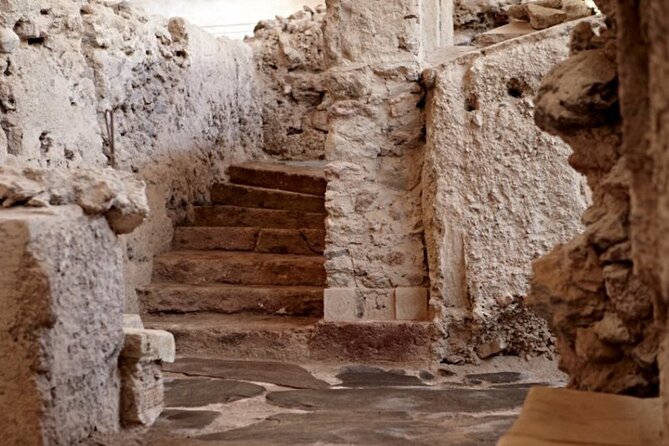
The main attraction is the settlement itself. You walk along cobbled alleys and between high-rise buildings that once formed part of a busy Aegean town. The phrase high-rise sounds modern, but it points to an important fact: Akrotiri was not a simple collection of one-room huts.
The buildings had multiple floors and carefully arranged rooms. That layout tells you about planning, work, storage, and household life. A guide can help you read these remains as parts of a functioning town instead of disconnected walls.
One of the larger buildings had at least two floors and 14 rooms on each floor. Several rooms were connected by many doors and decorated with murals. That detail makes the building especially useful for understanding how people used space. You can imagine movement between rooms, separate work areas, and interiors designed to be seen as well as used.
The remains are impressive, but you should set your expectations correctly. This is an archaeological site, not a fully rebuilt ancient city. Some areas will appear as foundations, walls, openings, and preserved structural sections. The guide’s explanation matters because the original purpose of a room may not be obvious at first glance.
The West House and the practical side of ancient life
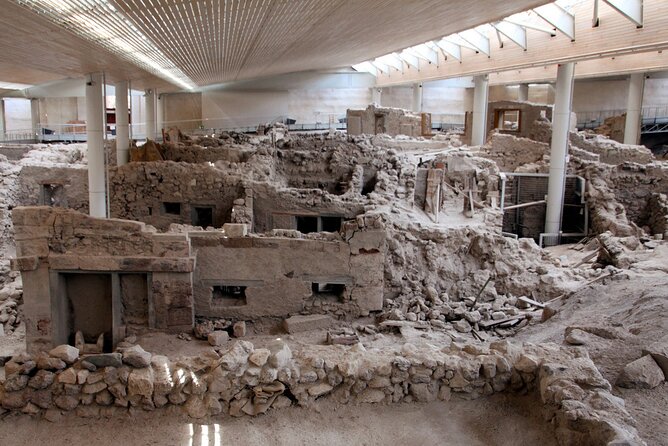
The West House is smaller than the large building described above, but its value comes from its organization. The ground floor included warehouses, workshops, a kitchen, and a mill installation.
This is one of the most useful parts of the visit for anyone who wants to see how people worked. Grand murals receive much of the attention at ancient sites, but storage rooms and workshops often tell you more about ordinary routines. The West House lets you think about food preparation, production, storage, and household management.
I like this section because it gives the settlement a human scale. You are not only hearing about an ancient civilization in broad terms. You are looking at the spaces that supported daily tasks.
The guide can also help connect these rooms to the wider settlement. Without that explanation, you might notice a wall or floor but miss why its arrangement matters. A clear English presentation is particularly useful here, and the available feedback specifically praised the guide’s ability to explain the site in an easy-to-understand way.
More Santorini tours worth comparing
- Santorini: Sunset Guided Tour with Hotel Pickup
★ 4.8 · 900 reviews - Santorini: Island Highlights Guided Day Trip with Oia Sunset
★ 4.4 · 713 reviews - Santorini: Guided Tour to 3 Wineries with Wine Tastings
★ 4.8 · 693 reviews - Santorini: Thirassia Islands and Volcano Guided Cruise
★ 4.4 · 650 reviews
The Women’s House and its mural
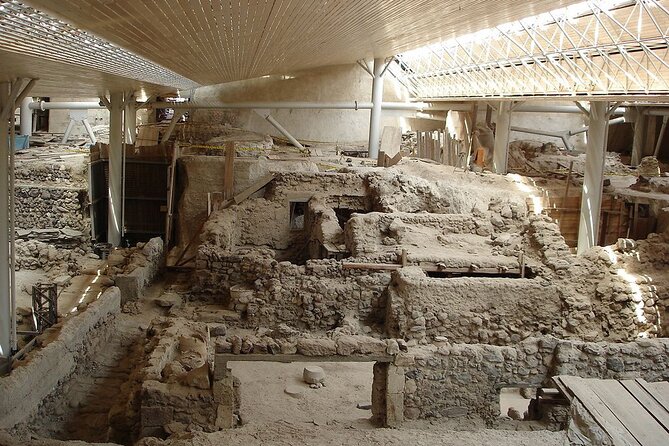
The Women’s House is a large two-story building named for the mural of the Ladies and the Papyrus. The painting decorated the interior and gives this building a clear identity within the site.
The name can make the building sound narrowly defined, so listen carefully to the guide’s explanation rather than assuming the title tells you everything about its use. What you can see is a substantial structure with decorated rooms, multiple levels, and a connection to one of Akrotiri’s best-known artistic remains.
Murals change the mood of an archaeological visit. Walls and foundations show how a building was built, while painted scenes hint at the tastes and ideas of the people who lived there. The Women’s House is therefore an important stop for visitors who want both architecture and art.
You should also remember that the site’s most famous paintings may be preserved or displayed in ways that limit what you can see in place. The tour information confirms the mural’s connection to the building, but it does not promise a full collection of original murals during this walk. The guide is the person to ask for a clear explanation of what remains at the site and what you are viewing.
What the guide adds to a short visit
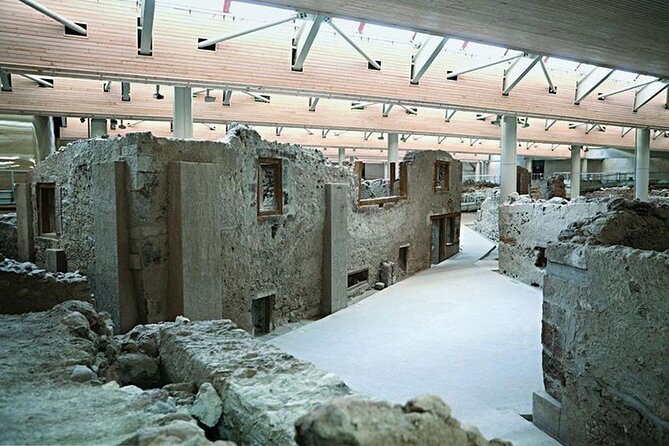
Akrotiri is not the easiest place to understand by reading a few signs as you pass. The settlement is large enough to contain many details, yet ancient enough that its rooms do not always explain themselves.
A good guide gives you a sequence. First, you learn what happened to the settlement. Then you see how the streets, houses, storage areas, workshops, and decorated rooms fit together. That order helps you build a mental picture instead of collecting random facts.
The guide is licensed and speaks English. One available assessment praised the guide as exceptional, easy to understand, and highly informed about the site. No guide name is provided, so you should not book this expecting a particular named person. You are booking the service and its English-language explanation.
The shared format is also worth weighing. A maximum of 20 people keeps the cost below a private experience, but you will not control the pace in the same way you would with a one-to-one guide. If you like asking many questions or stopping for long photographs, a private visit might suit you better. If you want a clear overview without doing all the research yourself, this format makes sense.
Is $181.10 a good value?
The listed price is $181.10 per person, and the €20 admission fee is not included. That means you should treat the total as the tour price plus the entrance charge, not as an all-in archaeological ticket.
For a two-hour archaeological visit, the figure is high. The value depends on what you are paying for: an English-speaking licensed guide, the shared transfer from and back to the Fira meeting point, and the convenience of having the site explained in a short block of time.
The group limit of 20 helps keep the price down compared with a private tour. Still, you should compare this experience with the cost of entering Akrotiri independently if you are comfortable arranging your own transport and reading the site at your own pace.
I would consider the tour more worthwhile if you have limited time in Santorini, want the structure of a guided visit, or prefer not to work out the site on your own. It is less attractive if your main goal is simply entry and you are happy exploring without a guide.
Children ages 0 to 18 enter the excavations free, but the tour price itself is listed per person. Confirm the final booking total carefully so the separate entrance charge does not surprise you.
Timing, group size, and the rest of your day
The compact schedule is one of the tour’s strongest practical features. After the Akrotiri visit, you have the rest of the day available for Fira, another part of the island, or a relaxed meal.
You should still allow time around the official duration. The visit is described as about two hours, while the overall activity is approximately two hours and 30 minutes. Group transfers and meeting arrangements can take time, so keep a buffer if you have a ferry, dinner reservation, or sunset plan.
The tour is offered in English only. Most people can participate, and the activity is near public transportation. No special accessibility details are provided, so if you have mobility needs, contact the provider before booking rather than guessing how the archaeological paths will suit you.
The experience requires good weather. If poor weather cancels it, you are offered another date or a full refund. You can cancel for a full refund up to 24 hours before the start time, but changes or cancellations inside that window are not accepted.
Who will enjoy this Akrotiri tour most?
I would recommend it to you if you want archaeology with explanation, not just a ticket. It is a good match for first-time visitors to Santorini who want to understand the island’s volcanic past and for anyone interested in ancient homes, murals, town planning, and domestic work.
Families may also find the short duration manageable, especially since children ages 0 to 18 enter the excavations free. The guide can give younger visitors a story to follow: a town flourished, people lived and worked in these rooms, and a major eruption changed everything.
The tour is less suitable for you if you want a private guide, a very slow photographic visit, or the lowest possible cost. The group may contain up to 20 people, and admission is an extra charge.
It is also not the right choice if you need a fully detailed accessibility plan, since the available information says most people can participate but gives no specific route or mobility guidance.
My verdict on booking
Book this tour if you want a short, organized introduction to Akrotiri and value a licensed English-speaking guide who can make the ruins readable. The site itself is one of Santorini’s most meaningful stops, and the West House, the large multi-room building, and the Women’s House give the visit real variety.
Think twice if $181.10 per person already feels high before adding the €20 entrance fee. In that case, independent entry may offer better value, provided you are comfortable arranging your own visit and learning without a guide.
For many visitors, the deciding point is not the ruins alone. It is the convenience of meeting in Fira, traveling with a capped group, hearing a clear explanation, and finishing in time for the rest of the island. If that combination fits your plans, this is a practical way to give Santorini’s ancient past a proper look.
FAQ
How long does the Akrotiri tour last?
The experience lasts approximately two hours and 30 minutes. The archaeological visit itself is described as about two hours.
Where does the tour start and end?
It starts and ends at KTEL Santorini in Fira, near the old hospital on Eparxeio. Transfer from and back to the meeting point is included.
Is the entrance fee included?
No. Admission to the Akrotiri excavations costs €20 per person and is paid separately. Entrance is free for children ages 0 to 18.
What language is the tour offered in?
The tour is offered in English and includes a licensed English-speaking guide.
How many people can join the group?
The activity has a maximum group size of 20 people.
Can I cancel for a refund?
Yes. You can cancel at least 24 hours before the experience starts for a full refund. Cancellations or changes made less than 24 hours before the start time are not accepted. If poor weather causes the tour to be canceled, you are offered another date or a full refund.
Newest reviews from Santorini
- Santorini: Full-Day Small Group Tour★ 5.0 · 3 reviews
- Guided Tour: the Myth of Lost Atlantis★ 5.0 · 3 reviews
- Private Boat tour with snorkeling & Sea Caves★ 5.0 · 3 reviews
- Akrotiri: Singles’ Aromatherapy Massages★ 5.0 · 3 reviews
- Private Transfer from Santorini Airport to Santorini★ 5.0 · 3 reviews
- Santorini: Island Tour for Cruise Travelers★ 5.0 · 3 reviews
- Top Spots Bus Tour in Santorini with Transportation★ 3.5 · 3 reviews
- Half-Day Private Experience to Santorini Beach★ 5.0 · 3 reviews
Akrotiri Excavations Tours, compared.

Archaeological Bus Tour To Akrotiri Excavations & Red Beach
Read our review →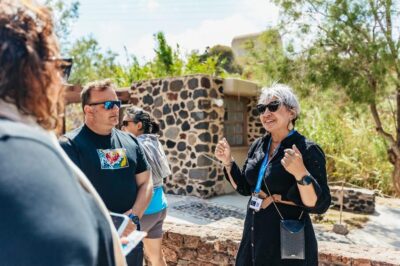
Archaeological Bus Tour to Akrotiri Excavations & Red Beach
Read our review →
Private Cultural Villages Sightseeing & Akrotiri Excavations
Read our review →

Private Group Visit to Akrotiri & 3 Wineries with Tastings
Read our review →Browse the lists this tour appears in